
- This event has passed.
Cancer Survivor’s Day
Event Navigation
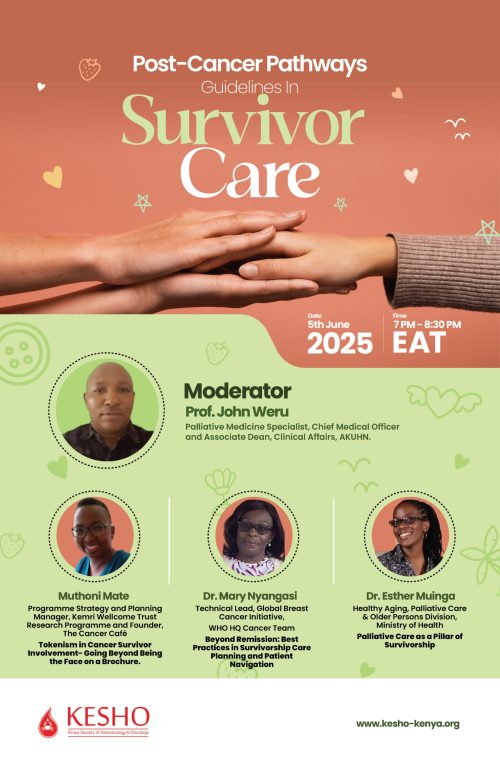
Moderator: Prof John Weru
Speakers & Topics:
- Muthoni Mate: Tokenism in Cancer Survivor Involvement – Beyond Being the Face on a Brochure
- Dr Mary Nyangasi: Beyond Remission – Best Practices in Survivorship Care Planning & Patient Navigation
- Dr Esther Muinga: Palliative Care as a Pillar of Survivorship
Muthoni Mate highlighted the issue of tokenism where survivors are symbolically included without influence. She called for shifting from consultation to co-design and recognizing survivors as experts by experience. Obstacles include medical jargon, lack of trauma-informed engagement, minimal institutional support, and preference for academic voices. True engagement must be collaborative, compensated, and empowering, allowing survivors to shape policy and practice. She urged stakeholders to move beyond the ‘face on the brochure’ and include survivors meaningfully in healthcare decision-making.
Dr. Nyangasi emphasized the critical role of survivorship care planning and patient navigation in ensuring long-term quality of life for cancer survivors. She outlined survivorship as a continuum beginning at diagnosis, extending beyond acute care into surveillance, psychosocial support, and lifestyle guidance. Evidence from over 60 systematic reviews shows that patient navigation improves care access, adherence to follow-up, and satisfaction. Barriers in Kenya include weak health systems, low awareness, lack of funding, and absence of integrated care protocols. There is urgent need for structured survivorship models and investment in navigation programs with proven return on investment.
Dr. Muinga presented palliative care as integral to survivorship, aiming to improve quality of life through pain control, emotional support, and end-of-life care. She emphasized the interconnectedness of palliation, prevention, and health promotion. Effective survivorship care requires collaboration across disciplines and includes surveillance, psychosocial screening, and health education. Survivorship plans should empower patients and caregivers, incorporate national policies, and address financial and cultural challenges. She concluded that palliative care is not about dying—it’s about living fully post-treatment.