
- This event has passed.
Cervical Cancer Prevention and Control In Kenya
Event Navigation
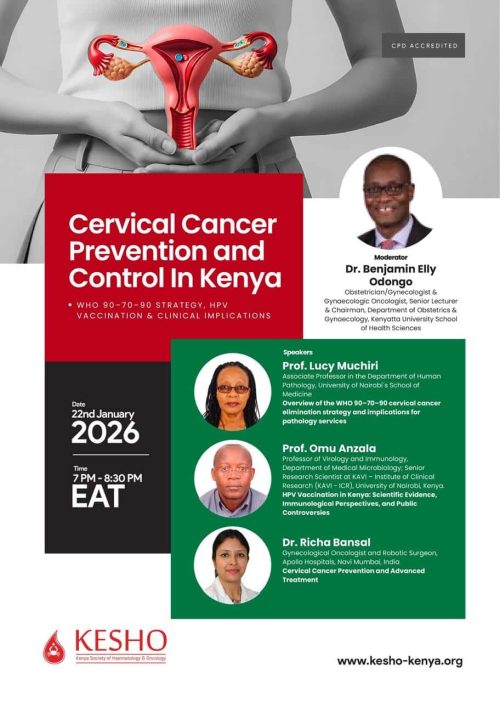
(CPD Accredited)
Date & Time: 22nd January 2026 7 PM – 8:30 PM (EAT)
- Moderator: Dr. Benjamin Elly Odongo
Obstetrician/Gynecologist & Gynaecologic Oncologist, Senior Lecturer & Chairman, Department of Obstetrics & Gynaecology, Kenyatta University School of Health Sciences
Speakers:
Prof. Lucy Muchiri
Associate Professor in the Department of Human Pathology, University of Nairobi’s School of Medicine
Topic: Overview of the WHO 90-70-90 cervical cancer elimination strategy and implications for pathology services
Prof. Omu Anzala Professor of Virology and Immunology, Department of Medical Microbiology; Senior Research Scientist at KAVI – Institute of Clinical Research (KAVI – ICR), University of Nairobi, Kenya
Topic: HPV Vaccination in Kenya: Scientific Evidence, Immunological Perspectives, and Public Controversies
Dr. Richa Bansal Gynecological Oncologist and Robotic Surgeon, Apollo Hospitals, Navi Mumbai, India
Topic: Cervical Cancer Prevention and Advanced Treatment
Highlights
This session examined cervical cancer through the lens of prevention, highlighting it as one of the few cancers where elimination is both feasible and within reach.
A central theme was the WHO 90-70-90 strategy, which outlines a clear pathway to elimination through HPV vaccination, screening and timely treatment. Achieving these targets could reduce cervical cancer incidence to below 4 cases per 100,000 women, effectively transforming it into a rare disease.
The discussion emphasized that cervical cancer is almost entirely driven by persistent HPV infection, making it uniquely preventable through vaccination and early detection. Evidence shows that HPV vaccines are highly effective, with strong and sustained protection against high-risk HPV types responsible for most cases.
Despite this, the burden remains disproportionately high in low- and middle-income settings, including Kenya, where gaps in screening coverage, diagnostic capacity and referral pathways continue to limit early detection and timely treatment.
The role of pathology services emerged as critical, forming the diagnostic backbone for screening programs and treatment decisions. Expanding HPV DNA testing, strengthening laboratory systems and investing in workforce development were identified as key priorities for achieving national targets.
Across the session, a consistent message emerged: cervical cancer is preventable and eliminating it will depend on scaling what already works.
Key Takeaways
- Cervical cancer is one of the few cancers where elimination is achievable.
- The WHO 90-70-90 targets provide a clear, evidence-based roadmap.
- HPV vaccination and screening are high-impact prevention strategies.
- Strengthening pathology and diagnostic capacity is essential to progress.
- Closing gaps in access and coverage is critical to achieving equitable outcomes.