
- This event has passed.
Precision Pathways in Lymphoma
Event Navigation
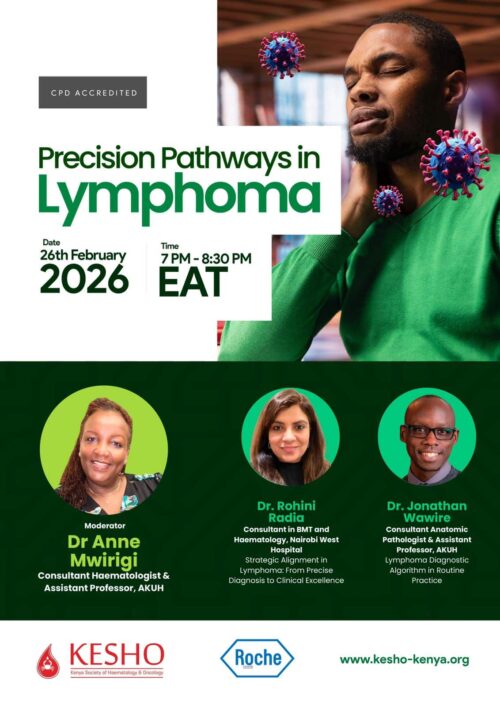
Date: 26th February 2026
Time: 7:00 PM – 8:30 PM (EAT)
Speakers
Moderator
Dr Anne Mwirigi
Consultant Haematologist & Assistant Professor, AKUH
Dr Rohini Radia
Consultant in BMT and Haematology, Nairobi West Hospital
Strategic Alignment in Lymphoma: From Precise Diagnosis to Clinical Excellence
Dr Jonathan Wawire
Consultant Anatomic Pathologist & Assistant Professor, AKUH
Lymphoma Diagnostic Algorithm in Routine Practice
Highlights
This session explored how lymphoma care is increasingly shaped by the alignment between diagnostic precision and therapeutic decision-making, particularly in settings where access to advanced diagnostics remains variable.
A central theme was the shift from morphology-led classification alone to a multi-parameter diagnostic approach, integrating clinical context, histopathology, immunophenotyping and where available, molecular profiling. As emphasized during the discussion, classification is no longer purely descriptive: it directly determines treatment pathways, prognosis and eligibility for emerging therapies.
Dr. Wawire outlined a structured diagnostic framework anchored on architecture, cytology and clonality, with morphology guiding the initial pathway and targeted immunohistochemistry refining classification. In routine practice, a focused IHC panel (CD20, CD3, CD5, CD10, Cyclin D1) remains sufficient to classify most lymphomas and support timely clinical decisions.
Importantly, the session addressed the practical realities of diagnostic limitations. The distinction between “Not Otherwise Specified (NOS)” and “Not Further Classified (NFC)” was highlighted as a clinically responsible approach where molecular testing is unavailable maintaining transparency while ensuring patients are still appropriately managed.
Building on this, Dr. Radia emphasized that improved outcomes depend on early alignment between diagnostics, treatment selection and delivery systems. In practice, delays in diagnostic workflows or limited access to molecular testing can directly influence treatment choices and patient outcomes making coordination across pathology, oncology and imaging essential.
As treatment options expand, from immunochemotherapy to targeted agents, CAR-T therapies and bispecific antibodies, the need for early risk stratification and timely decision-making becomes even more critical, particularly in balancing efficacy, cost and access within real-world settings.
Across the case discussions, a consistent message emerged: the quality and timeliness of diagnosis remain central to achieving better outcomes in lymphoma care.
Key takeaways:
- Lymphoma classification now relies on integrated clinical, morphological and molecular assessment.
- Focused IHC panels remain highly effective in routine and resource-limited settings.
- “NFC” supports safe, transparent reporting when advanced testing is unavailable.
- Diagnostic delays and access gaps can directly impact treatment decisions.
- Early alignment across disciplines is essential to optimize outcomes.