
- This event has passed.
Renal Cell Carcinoma: Evidence-Based Integration of Surgery and Systemic Therapy
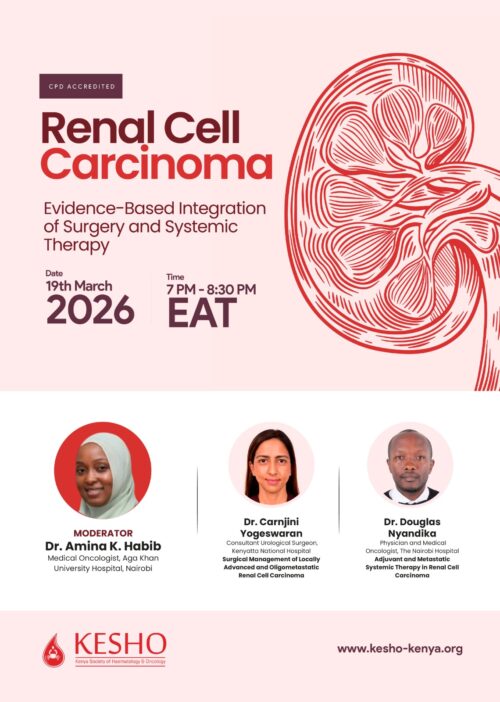
Evidence-Based Integration of Surgery and Systemic Therapy
Date: 19th March 2026
Time: 7 PM – 8:30 PM EAT
MODERATOR
Dr. Amina K. Habib
Medical Oncologist, Aga Khan University Hospital, Nairobi
Dr. Carnjini Yogeswaran
Consultant Urological Surgeon | Kenyatta National Hospital
Topic: Surgical Management of Locally Advanced and Oligometastatic Renal Cell Carcinoma
Dr. Douglas Nyandika
Physician and Medical Oncologist | The Nairobi Hospital
Topic: Adjuvant and Metastatic Systemic Therapy in Renal Cell Carcinoma
Highlights
This session examined the evolving management of renal cell carcinoma (RCC), focusing on how surgical and systemic approaches are increasingly integrated across the disease continuum.
A central theme was the importance of risk-adapted, multidisciplinary care, particularly in settings where many patients are still present with advanced diseases. While improved imaging has increased incidental detection globally, late-stage presentation remains common in Kenya, shaping both prognosis and treatment strategy.
From a surgical perspective, nephron-sparing surgery remains standard for localized diseases, while radical nephrectomy and complex resections play a critical role in locally advanced cases. In oligometastatic disease, cytoreductive nephrectomy and metastasis-directed therapy may offer benefit in carefully selected patients, particularly when integrated with systemic treatment strategies.
Systemic therapy has expanded significantly, with immune checkpoint inhibitors and targeted therapies now forming the backbone of treatment in advanced disease. Evidence from key trials demonstrates improved survival outcomes with combination regimens, reinforcing a shift towards early and strategic use of systemic therapy, particularly in metastatic and high-risk settings.
In the adjuvant setting, therapies such as pembrolizumab have shown disease-free and overall survival benefit in selected high-risk patients, highlighting the importance of post-surgical risk stratification and follow-up.
However, translating these advances into routine practice remains constrained by access, cost and infrastructure. The discussion underscored the need for context-specific treatment pathways, supported by multidisciplinary decision-making and strengthened health systems.
Across the session, a consistent message emerged: optimal RCC outcomes depend on deliberate integration—of surgery, systemic therapy and patient-centered decision-making.
Key Takeaways
- RCC management requires integration of surgical and systemic therapies.
- Late-stage presentation remains a key challenge in many settings.
- Nephron-sparing and radical surgery remain central to localized and advanced disease.
- Immunotherapy and targeted agents are transforming metastatic RCC outcomes.
- Adjuvant therapy is increasingly relevant in high-risk post-surgical patients.
- Access, cost and infrastructure continue to shape real-world implementation.