
- This event has passed.
Strengthening Haemato-Oncology Care
Event Navigation
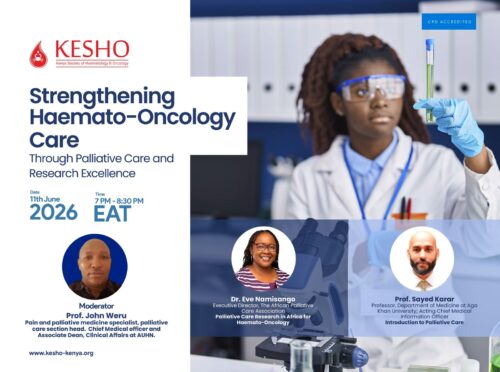
STRENGTHENING HAEMATO-ONCOLOGY CARE THROUGH PALLIATIVE CARE AND RESEARCH EXCELLENCE
- Moderator: Prof. John Weru
- Speaker: Prof. Sayed Karar
- Date: 11 June 2026
This session examined palliative care as a critical component of quality and comprehensive haemato-oncology care. The discussion challenged the misconception that palliative care belongs only at the end of life and instead presented it as an added layer of support that can be introduced early, alongside active treatment.
A central theme was the distinction between palliative care and hospice. Prof. Sayed Karar emphasized that palliative care can support patients and families at any stage of serious illness, including during chemotherapy, radiotherapy or other disease directed treatment. Hospice care, by contrast, is generally associated with advanced disease when curative options are no longer appropriate. The discussion framed palliative care as a holistic service that addresses pain, symptoms, psychological distress, spiritual concerns, social needs and family burden.
The session also situated palliative care within the African and Kenyan context. Prof. Karar highlighted the large unmet need for palliative care across the continent, the uneven availability of services, limited access to opioids and the continued underuse of affordable medicines such as morphine. Local studies were used to show how research can change practice, including ICU trigger models that help identify patients who should receive timely palliative care review.
Through case scenarios, the discussion explored difficult conversations, symptom control, prognostication, end of life feeding, dialysis decisions, family conflict and the role of faith and hope in care decisions. Practical tools such as the SPIKES framework were discussed as a way to support clear, compassionate communication. The session also reinforced the importance of identifying the appropriate decision maker, using plain language and allowing families time to process serious news.
Across the session, a consistent message emerged: palliative care is not about withdrawing care. It is about strengthening care, relieving suffering, supporting decision making and helping patients and families navigate serious illness with dignity.
Key Takeaways
- Palliative care should be introduced early and can run alongside active haemato-oncology treatment.
- Hospice and palliative care are related but not the same; palliative care is appropriate at any stage of serious illness.
- Pain control requires careful assessment, stepwise treatment, safe opioid use and attention to side effects such as constipation.
- Difficult conversations need preparation, privacy, clear language, empathy and structured follow up.
- Local palliative care research can influence practice, including the use of triggers to identify patients who need timely review.
- Every clinician should have basic palliative care skills, especially in settings where specialist services are limited.