
- This event has passed.
Advancing Hodgkin Lymphoma Care
Event Navigation
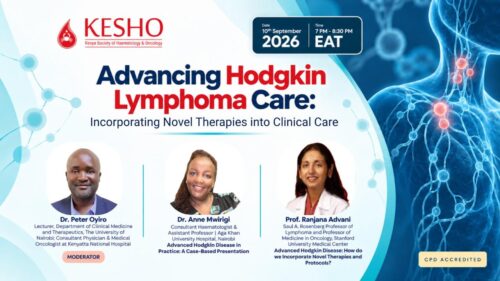
ADVANCING HODGKIN LYMPHOMA CARE: INCORPORATING NOVEL THERAPIES INTO CLINICAL CARE
- Moderator: Dr Peter Oyiro
- Speakers: Dr Anne Mwirigi, Prof Ranjana Advani
- Date: 10 September 2026
This session examined how Hodgkin lymphoma care is evolving as PET-adapted strategies and novel therapies become increasingly integrated into clinical practice, while keeping cure, toxicity and access in balance.
Dr Anne Mwirigi used clinical cases to highlight two practical challenges: treatment failure can still occur despite a negative interim PET, and tissue confirmation remains essential when the clinical course changes. The discussion reinforced the need to pursue an adequate biopsy rather than rely on presumptive diagnoses, particularly where lymphoma may be mistaken for conditions such as tuberculosis.
Prof Ranjana Advani reviewed contemporary treatment across early and advanced-stage disease. She discussed how more precise radiotherapy has reduced exposure to normal tissues, while PET-adapted approaches continue to refine the balance between cure and long-term toxicity. In early-stage disease, established combined-modality treatment remains important, as current evidence does not yet support routinely replacing radiotherapy with novel agents.
The session also explored the expanding role of brentuximab vedotin and checkpoint inhibitors such as nivolumab and pembrolizumab in advanced, relapsed and refractory Hodgkin lymphoma. In advanced disease, novel-agent combinations are improving outcomes, while treatment selection should consider disease risk, physiological fitness and expected toxicity rather than age alone.
Access and affordability remained central to the discussion. The speakers highlighted the need for locally relevant research, including collaborative studies of lower-dose checkpoint inhibition, alongside stronger tumour boards, shared pathology expertise, registries and tissue banking. Across the session, the message was clear: Hodgkin lymphoma care is moving toward greater individualization, but better outcomes will also depend on stronger diagnostic and research systems.
Key Takeaways
- A negative interim PET does not completely exclude later treatment failure.
- Tissue diagnosis remains essential when lymphoma is suspected or disease behaviour changes.
- Novel agents are expanding options in advanced, relapsed and refractory Hodgkin lymphoma.
- Treatment intensity should reflect disease risk, physiological fitness and toxicity, not age alone.
- Access challenges strengthen the case for locally relevant research and stronger collaborative lymphoma systems.