
- This event has passed.
Bridging Surgery and Oncology in Head & Neck Cancer
Event Navigation
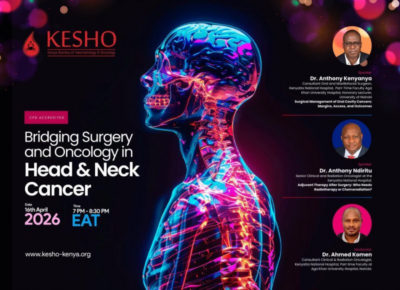
- Moderator: Dr. Ahmed Komen
- Speakers: Dr. Anthony Kenyanya, Dr. Anthony Ndiritu
- Date: 16 April 2026
This session explored the management of head and neck cancer with particular attention to how surgical decisions and oncology pathways must align from the outset. Through oral cavity cancer as a key focus, the session examined resectability, margins, nodal management, reconstruction, adjuvant therapy and functional outcomes.
A central theme was that treatment planning must go beyond tumour removal. Dr. Anthony Kenyanya highlighted the importance of staging, imaging, pathology, dental and nutritional assessment, surgical access, margin planning and neck node evaluation. In oral cavity cancers, surgical success depends not only on clear oncologic resection, but also on the ability to reconstruct defects and preserve speech, swallowing, appearance and quality of life.
The discussion also emphasised the challenge of late presentation and complex anatomy. Selective neck dissection, sentinel node considerations, access procedures such as mandibulotomy, and the reconstructive ladder were framed as tools for balancing disease control with morbidity. The role of the pathologist and margin assessment was highlighted as central to determining risk and guiding further treatment.
Dr. Anthony Ndiritu built on this by outlining how radiotherapy and chemoradiation fit into early, locally advanced, post-operative, recurrent and metastatic diseases. Early-stage disease may often be treated with a single modality, while locally advanced disease requires careful integration of surgery, radiotherapy and chemotherapy.
Positive margins and extranodal extension were discussed as major indications for post-operative chemoradiation, with timely initiation of treatment after surgery being important. The session also addressed treatment technique, patient fitness, nutrition, supportive care and the need to tailor recommendations to the services and expertise available.
Across the session, a consistent message emerged: head and neck cancer care is as much about function, coordination and follow-through as it is about disease control.
Key Takeaways
- Head and neck cancer decisions must integrate tumour stage, resectability, patient fitness and functional outcomes.
- Margin planning, pathology reporting and neck node assessment directly shape adjuvant treatment decisions.
- Surgery requires strong reconstruction and rehabilitation planning to preserve speech, swallowing and appearance.
- Locally advanced disease often needs combined-modality treatment through an MDT approach.
- Positive margins and extranodal extension are key triggers for post-operative chemoradiation.
- Supportive care, nutrition and patient navigation are essential to treatment completion.