
- This event has passed.
Implementing Precision Oncology in LMICs
Event Navigation
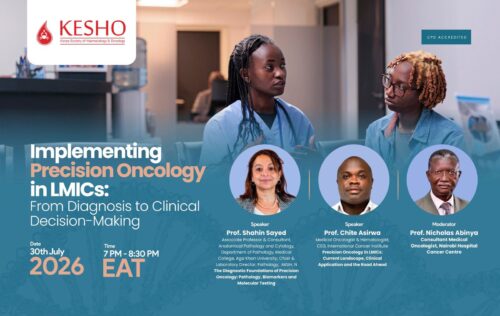
Implementing Precision Oncology in LMICs:
From Diagnosis to Clinical Decision-Making
Date: 30th July 2026
Time: 7 PM – 8:30 PM EAT
Speaker
Prof. Shahin Sayed
Associate Professor & Consultant, Anatomical Pathology and Cytology, Department of Pathology, Medical College, Aga Khan University; Chair & Laboratory Director. Pathology, AKUH, N
The Diagnostic Foundations of Precision Oncology: Pathology, Biomarkers and Molecular Testing
Speaker
Prof. Chite Asirwa
Medical Oncologist & Hematologist; CEO, International Cancer Institute
Precision Oncology in LMICs: Current Landscape, Clinical Application and the Road Ahead
Moderator
Prof. Nicholas Abinya
Consultant Medical Oncologist, Nairobi Hospital Cancer Centre
Summary
This session examined what meaningful precision oncology looks like in low- and middle-income countries, connecting clinical decision-making with pathology, molecular diagnostics, patient factors, health-system capacity and access to treatment.
A central theme was that precision oncology is broader than genomic sequencing. Prof. Chite Asirwa described it as the integration of clinical, pathological, molecular, environmental and patient-specific information across diagnosis, prognosis, treatment selection and monitoring. Used well, this approach can reduce ineffective empirical treatment, limit unnecessary toxicity and direct limited resources towards interventions most likely to benefit the patient.
Prof. Shahin Sayed focused on the diagnostic foundations that make precision care possible. High-quality tissue, correct fixation and handling, validated assays, quality assurance and clinically useful reporting all determine whether a molecular result can be trusted. The discussion reinforced that advanced testing cannot compensate for weak foundational pathology, and that essential immunohistochemistry and biomarker testing remain an important starting point for many settings.
The session also addressed Africa’s underrepresentation in genomic datasets and the challenge of interpreting variants when locally relevant reference data are limited. Molecular results need clinical context and, where possible, multidisciplinary interpretation. Liquid biopsy and circulating tumour DNA were discussed as promising tools for selected applications, but standardisation, quality control and careful use remain important, particularly when considering screening.
Implementation was therefore framed as a phased health-system journey rather than a technology purchase. Strong pathology services, reliable essential biomarkers, regional molecular capacity, better patient navigation, financing and locally generated data must develop together. Across the session, a consistent message emerged: precision oncology has greatest value when a reliable test leads to a clinically meaningful decision and an accessible treatment pathway.
Key Takeaways
- Precision oncology integrates clinical, pathological, molecular and patient-specific information rather than genomics alone.
- Accurate pathology, specimen quality and laboratory quality assurance are foundational to every precision treatment decision.
- Essential biomarkers and immunohistochemistry should be strengthened before indiscriminate expansion into complex testing.
- African genomic data and multidisciplinary interpretation are needed to improve the relevance of molecular results.
- Testing has limited value when results cannot be linked to accessible treatment, making financing and patient navigation part of precision care.
Continue the learning
This summary captures only part of the discussion. To request the full session recording, contact the KESHO Secretariat. KESHO members can access CME recordings and revisit expert-led sessions across haematology and oncology throughout the year. Join KESHO to access the full CME learning library.