
- This event has passed.
Management of Endometrial Cancer
Event Navigation
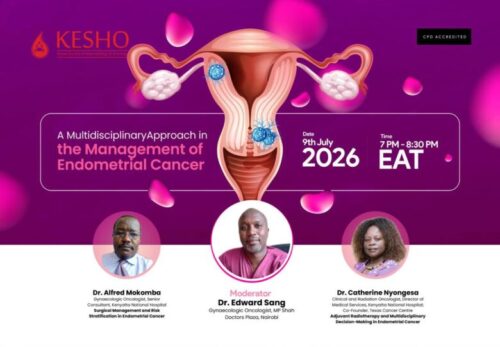
A Multidisciplinary Approach in the Management of Endometrial Cancer
📅 9th July 2026
⏰ 7PM – 8:30PM EAT
Join our expert panel:
👨⚕️ Dr. Alfred Mokomba — Surgical Management and Risk Stratification
👩⚕️ Dr. Catherine Nyongesa — Adjuvant Radiotherapy and Multidisciplinary Decision-Making
🎙️ Moderated by Dr. Edward Sang
Summary
This session examined endometrial cancer through a multidisciplinary lens, linking early recognition and tissue diagnosis with surgical planning, molecular risk classification and adjuvant treatment.
A central theme was that treatment decisions increasingly depend on both traditional clinicopathological risk factors and tumour biology. Dr. Catherine Nyongesa reviewed stage, grade, depth of myometrial invasion, lymphovascular space invasion and histology alongside the molecular groups defined by POLE mutation, mismatch repair deficiency, non-specific molecular profile and p53 abnormality. The discussion highlighted the practical value of mismatch repair and p53 immunohistochemistry, which can help refine prognosis and guide treatment even where broader molecular testing is limited.
Radiotherapy was presented as a risk-adapted component of care. Vaginal brachytherapy remains an important option for appropriately selected high-intermediate-risk patients, while pelvic external beam radiotherapy is reserved for patients with greater pelvic or nodal risk. In higher-risk disease, particularly stage III and p53-abnormal tumours, chemotherapy and combined-modality approaches become increasingly relevant.
Dr. Alfred Mokomba focused on the diagnostic and surgical pathway. Postmenopausal bleeding was emphasised as a warning sign that should prompt investigation rather than reassurance. Endometrial sampling should establish histology before definitive surgery, supported by imaging and appropriate staging. The extent of surgery and nodal assessment should then reflect disease stage, histology and risk rather than following a uniform approach.
Across the session, a consistent message emerged: endometrial cancer outcomes depend on getting the sequence right from the beginning. Early recognition, accurate pathology, risk-adapted surgery and coordinated adjuvant treatment allow the multidisciplinary team to individualise care while using available resources more effectively.
Key Takeaways
- Postmenopausal bleeding should prompt timely investigation and tissue diagnosis.
- Stage, histology, myometrial invasion, lymphovascular invasion and molecular class all contribute to risk stratification.
- Mismatch repair and p53 immunohistochemistry can provide clinically useful molecular information in resource-constrained settings.
- Brachytherapy, pelvic radiotherapy and chemotherapy should be selected according to recurrence risk and tumour biology.
- Surgery should be planned within a multidisciplinary pathway and followed by review of final pathology and adjuvant needs.
Continue the learning
This summary captures only part of the discussion. To request the full session recording, contact the KESHO Secretariat. KESHO members can access CME recordings and revisit expert-led sessions across haematology and oncology throughout the year. Join KESHO to access the full CME learning library.