
- This event has passed.
Sickle Cell Disease
Event Navigation
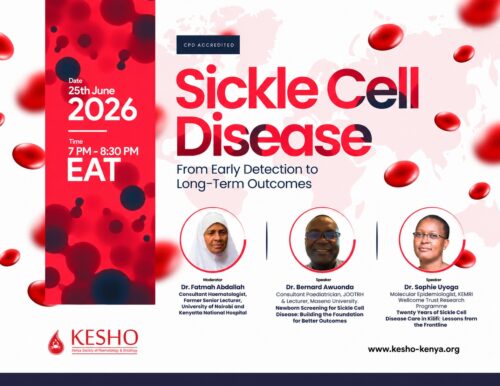
SICKLE CELL DISEASE: FROM NEWBORN DETECTION TO LONG-TERM OUTCOMES
- Moderator: Dr. Fatmah Abdallah
- Speakers: Dr. Bernard Awuonda and Dr. Sophie Uyoga
This session examined sickle cell disease through the full patient pathway, from newborn detection and early diagnosis to long-term care, survival and health-system readiness.
Dr. Bernard Awuonda opened the session by situating sickle cell disease as an inherited haemoglobin disorder and emphasising the importance of public education in reducing stigma. The discussion highlighted that sickle cell disease is not contagious and that clear communication with families and communities is essential for improving understanding, genetic counselling and health-seeking behaviour.
A major focus of the session was the burden of sickle cell disease in sub-Saharan Africa and Kenya. Dr. Awuonda noted that without timely intervention, many children born with sickle cell disease in high-burden settings die before the age of five. This framed the case for newborn screening as a life-saving public health intervention, rather than a specialist service alone.
The discussion explored screening modalities, including point-of-care testing and laboratory-based approaches, and highlighted the importance of linking screening to action. Early detection only improves outcomes when it is followed by caregiver education, prophylactic care, vaccination, access to hydroxyurea where appropriate, routine monitoring and clear referral pathways.
Dr. Sophie Uyoga shared experience from Kilifi, where structured sickle cell care has combined clinical service delivery, research, patient follow-up and community engagement. The session highlighted how early testing, routine monitoring, access to hydroxyurea and caregiver education can improve survival and health-seeking behaviour.
The discussion also addressed the realities of long-term care, including transition from paediatric to adult services, psychosocial support, affordability, access to diagnostics, transfusion planning and the importance of maintaining patients in care. The speakers emphasised that sickle cell disease should not be viewed as a death sentence. With early diagnosis, structured follow-up and supportive systems, patients can live fuller and longer lives.
The session reinforced the need to operationalise infant screening policy, strengthen financing, improve point-of-care capacity, support data systems and build care pathways that connect newborn screening to lifelong care.
Key Takeaways
- Newborn screening is critical for early identification and timely intervention in sickle cell disease.
- Screening must be linked to care, including caregiver education, prophylaxis, vaccination, routine monitoring and referral pathways.
- Sickle cell disease is inherited and not contagious; community education remains important for reducing stigma.
- Hydroxyurea, routine monitoring and structured clinical follow-up can reduce complications and improve outcomes.
- Transition from paediatric to adult care requires stronger planning, psychosocial support and retention strategies.
- Policy, financing, data systems and point-of-care testing are essential for scaling sickle cell care across Kenya.